
2022counter for years (following a number in the hito-futa-mi counting system)4month2day, the Yemeni conflict was agreed upon by both parties.2A full cease-fire lasting for a period of three months has been initiated. Since the ceasefire was agreed upon, there has been an improvement in the humanitarian crisis due to a decrease in armed actions on the front lines and an increase in the importation of fuel, which had been in short supply. Then the ceasefire agreement expired.6month2From the date of the2I want a cease-fire for a month.extensionThe decision was also made to make the longtime interim president Also, Abdo Rabbo Mansour Hadi, the longtime sitting interim president, has been4month7He resigned from the presidency on April 1, and the newly createdpresidential councilPresidential authority was delegated outside Yemen to the Saudis in Saudi Arabia.
The Yemen conflict is2014The armed conflict, which began in 2006, is primarily between the Houthis, who ousted interim President Hadi and took control of the capital, and the Hadi government, which was ousted from the capital, and the Saudi Arabia-centered Arab countries that support it. In addition to these forces, several other forces are involved, and the violent armed conflict is7In Yemen, which had been going on for a year,food insecurityand ... andLack of medical servicesThe spread of disease due to, for example,World's Worst Humanitarian CrisisThe situation is called "the
Several times in the past.GNVAlso authored bytopicHowever, we would like to address once again not only the latest developments, but also the background, complexity, and humanitarian crisis of this conflict.

Buildings destroyed in an airstrike near Aden (Photo:EU Civil Protection and Humanitarian Aid / Flickr [CC BY-NC-ND 2.0]
Table of Contents
A Brief History of the Yemen Conflict
We begin with a brief history of the Yemen conflict. The North Yemen region is1918It became independent as a kingdom from Ottoman rule in 1949 and has since1962The monarchy was abolished in 1949 and the Yemeni Arab Republic was established. The South Yemen region is19Although Aden has been a British territory since the 19th century,1967It became independent as the People's Republic of South Yemen in 1949.Republic of Yemenschool (e.g. of ikebana)1990The country was formed by the unification of North and South Yemen in 1949. Soon after the unification of the north and south, the two countries have been at odds over issues such as power and resource differences between the north and south,1990Since the year1994over the course of the yeararmed conflictThe situation was unstable, with the occurrence of
2004In 2006, the Houthi sect of the Zayd forces, an offshoot of the Shiite sect, took up arms and launched an insurgency against the regime led by President Ali Abdullah Saleh. Saleh was the first president of the Republic of Yemen.1990The authoritarian regime had been in place since 1949. on economics and politics.dissatisfactionIn addition to,2003The conflict between the Houthis and the Saleh regime intensified due to the Saleh regime's support for the war waged by the U.S., including the invasion of Iraq in 1979, and the Houthis repeatedly conducted anti-government activities. However, the battlefield at that time was mainly limited to the Houthi stronghold of Sa'ada province in northern Yemen.
2011A series of democratic movements in the Middle East and North Africa in 1949, theArab Spring."President Saleh was ousted by the Hadi, who had been acting president since then, became the new president.Inauguration.ButTwo year term(*)1It was an interim government that was given only the
2014In 1949, the Houthis overran the capital Sanaa and began to move southward toward the second city of Aden. The government base was moved to the southern city of Aden the following year.2015In 2006, President Hadi gave Saudi ArabiaescapeAden was without a president. Aden was left without a president, making it difficult for the government (hereafter referred to as the interim government) to function and govern. Then, in response to the advance of the Houthis, Saudi Arabia, in the name of suppressing the Houthis and restoring the Hadi government, established the United Arab Emirates (UAEAlong with other Arab countries such asunion(hereafter referred to as the Saudi Coalition Forces). The coalition forces then took the side of the interim government, dispatching ground troops and launching air strikes. Meanwhile, former President Ali Abdullah Saleh, who saw this situation as an opportunity to return to his post, was forced to join the Houthi faction.assistanceThe company will do the same. Furthermore, the government has taken advantage of this chaos to create an al-Qaeda in the Arabian Peninsula (theAQAP) and the Islamic State, which was based in Iraq and Syria (ISExtremist forces such as those in Yemen will also expand their influence in Yemen.

Saudi Air Force F-15C (Photo:Saudi88hawk / Wikimedia Commons [CC BY-SA4.0])
2017In 2006, former President Saleh and the HouthisfarewellThe first time, the company was in a position to do so.2016Relations between the two groups were unstable, with the Houthis accusing former President Saleh of calling the Houthis "militia" in 2006, and relations deteriorating sharply when a former senior member of Saleh's party and close aide was shot dead. And.2017A few days after former President Saleh announced in a speech in 2006 that he was formally severing ties with the Houthis and that he was open to dialogue with the Saudi coalition forces, he was murdered by the Houthis. And.2018Saleh supporters to the Saudi coalition forces in 2006.joinedThe following is a list of the most common problems with the
A split was also seen in the anti-Houthi forces. The separatists, who claim secession in the south, have been fighting the Houthis for many years together with the provisional government and Saudi coalition forces,2017Since the year2The relationship had deteriorated over the years.2017counter for years (following a number in the hito-futa-mi counting system)4Tensions rose in May when Hadi dismissed the governor of Aden, Aydarous al-Zubeidi. The following month, thousands of Aden residents took to the streets to protest Mr. Hadi, reviving the southern movement for autonomy and secession in southern Yemen. The dismissed al-Zubeidi was appointed to the Southern Transitional Council (STC), and the conflict with the provisional government escalates.
2018counter for years (following a number in the hito-futa-mi counting system)1Month.STChas taken control of almost all of Aden and surrounded the presidential palace, and bothbattleoccurred, though,UAEschool (e.g. of ikebana)STCThe company had begun to support theSTCand the main Saudi Arabian allied forces, due to the conflict between the interim government, Saudi Arabia and the Saudi Saudi-Arab coalition forces.UAECracks also appeared in the relationship between the2019counter for years (following a number in the hito-futa-mi counting system)8Also at Aden in May.STCThe army and the coalition forces of the provisional government and Saudi Arabia clashed, and the recapture of Aden was followed by repeated counterattacks, resulting in many deaths. However, in the same year10Month,UAEis the ground troops from Aden.withdrawalannounced the new project.
2021In 1949, the Houthis were the government's last stronghold in the north, in the heart of the oil-rich province ofMalibuThe attack on the In response, Hadi-Saudi coalition forces intensify their airstrikes in Marib, killing many Houthis,2021Civilian casualties in Malibu in 2006 were the highest ever.3More than the annual total344 The number of people who have been in the area has risen to 1,000.
2022counter for years (following a number in the hito-futa-mi counting system)1In May, the Houthis move to seize control of Malibu,UAE The Houthis were faced with difficulties due to a counterattack by the coalition forces of the interim government and Saudi Arabia, backed by the In response, the Houthis attacked with drone missiles.UAEThe company began to set up in the2018Since 2006, the Houthis have targeted airports and oil facilities in Saudi Arabia.missile attackbut further increased the frequency of attacks. Saudi Arabia also stepped up its airstrikes against Sanaa and other populated areas.2022counter for years (following a number in the hito-futa-mi counting system)1In May, in an airstrike by Saudi coalition forces against a prison facility in Sa'ada Province,91Killed two detainees,226People were injured, and the past3In Yemen for a year.Worst civilian casualtiesThe result was the following. These Houthis versus Saudi Arabia andUAEDue to the intensification of the conflict in the2022counter for years (following a number in the hito-futa-mi counting system)1The number of civilian deaths in Yemen for the month of March is2015He said it was the most months ever since the conflict began in 2006.estimationThe following is a summary of the results of the study.

Yemen conflict power structure (as of January 2022) (Al Jazeera'sdata(Created based on)
It should be noted here that the attacks by the Houthis and the coalition forces of the interim government and Saudi Arabia are disproportionate. The coalition forces led by Saudi Arabia, the world's largest arms importer, are backed by the United States, the world's largest arms exporter, and other Western countries, and there is a big difference in military power between them and the Houthis, who do not have fighter aircraft. In fact, the number of attacks by the Houthis on oil facilities and other facilities is overwhelmingly small, and their destructive power is small, and the Saudi coalition forces have intercepted their missiles and suppressed major damage.reportThe company has been
Multiple forces involved
The dispute is a result of the presence of Saudi Arabia in the background of the interim government and Iran's support for the Houthis, which has led to a "war by proxySometimes referred to as "the Saudis," the involvement of Saudi Arabia and Iran in the conflict is very different, and the involvement of many other countries and armed forces in the conflict is also very different.Complex structurehave. Let's look at these parties as well below.

Relationship Diagram of Parties to the Conflict in Yemen (as of April 2022)
First,2014Name the forces on the side of the interim government that ruled Yemen until 2006. The Yemeni interim government and Saudi coalition forces,STCThe United States, the United Kingdom, France, Canada, and other Western countries.
The Houthi invasion of Sanaa had forced the interim Yemeni government to flee to Saudi Arabia, where interim President Hadi had fled to Saudi Arabia, and the government was based in the southern city of Aden. Having lost influence over the anti-Houthi forces, and with little leadership, the interim government was a governmentHardly functional.The following is a list of the most common problems with the
For the Saudi coalition forces.2015As of 2006, Bahrain, Egypt, Jordan, Kuwait, Morocco (2019until), Qatar (2017(until), Sudan,UAEandparticipationand conducted air strikes and ground operations in Yemen. Other Somalia has provided airspace, territorial waters, and military bases to coalition forces, and the Saudi coalition forces haveColombiaMany countries have now left the coalition, although some have gathered and dispatched mercenaries from
Southern Interim Council (STC) is a force that seeks autonomy or secession for South Yemen before the unification of North and South Yemen,2017in the yearformationThe main Mainly.UAEThe company has been receiving support from the The southern region around Aden is currently beingcontrolThe company has been at odds with the interim government. Although it has been at odds with the interim government,2022counter for years (following a number in the hito-futa-mi counting system)4The Presidential Council, which has had presidential authority since May, has more influence over anti-Houthi forces than former interim President Hadi, and the future relationship between the two groups isimprovementThe possibility of doing so exists.
The U.S. provides logistical support to the Saudi coalition forces by providing technical assistance, arms trade, and intelligence. Saudi Arabia imports weapons.almostis from the United States, in some form, such as target selection or fighter aircraft maintenance, for a significant portion of the Saudi-led aerial assaults.the US armed forcesare involved.
Other Western countries, such as the United Kingdom and France, have also sold arms to the Saudi coalition forces for the economic benefits of the arms trade. The United Kingdom and France are the second largest importers of Saudi arms after the United States, respectively.9%,4Percentage.in proportion toand that Canada is also complicit in the conflict through arms exports.It's been said.The following is a list of the most common problems with the

A flag with Houthi slogans (photo:Abdullah Sarhan / Wikimedia Commons [CC BY-SA 4.0])(*2)
Next, the Houthis, Iran, and Hezbollah are among the forces that are in conflict with the interim government and Saudi coalition forces.
Fushi Faction (of the LDP)school (e.g. of ikebana)2004It launched an insurgency against the interim government in 2006 and has occupied the capital Sanaa and other parts of northern Yemen.
Iran has repeatedly provided economic and military support to the Houthis, he said.It's been said.The company is a member of the Saudi Arabia and Saudi Arabia andUAEthat they are not directly participating in or supporting Houthi attacks, but only indirectly supporting them, as in the bombing campaign of theConsidered.
Hezbollah.1982The organization was formed after the Israeli invasion of Lebanon in 2006, and has received financial and weapons assistance from Iran since its formation. Saudi Arabia has been involved in Hezbollah's involvement on the Houthi side of the Yemen conflict.Claims.The,Hezbollahs involvement in the Yemen conflict is not clear.
Next, the above2Name other armed groups that are difficult to categorize into two groups.
AQAPis the al-Qaeda of the Arabian Peninsula. It has expanded its influence mainly in the east, antagonizing both the interim government and the Houthis, and has been active throughout Yemen in a number ofterrorist attackThe U.S., on the other hand, has repeatedly used drones and otherattackThe company is conducting the project.
IS is a militant group based in Iraq and Syria.ISbe beyond one's controlAQAPsimilarlyTerrorist attacks have been carried out all over the country.ISschool (e.g. of ikebana)AQAPthat it was considerably smaller in size and influence than theI've been told.and that he is at odds with AQAP.Seen by.The following is a list of the most common problems with the
humanitarian crisis
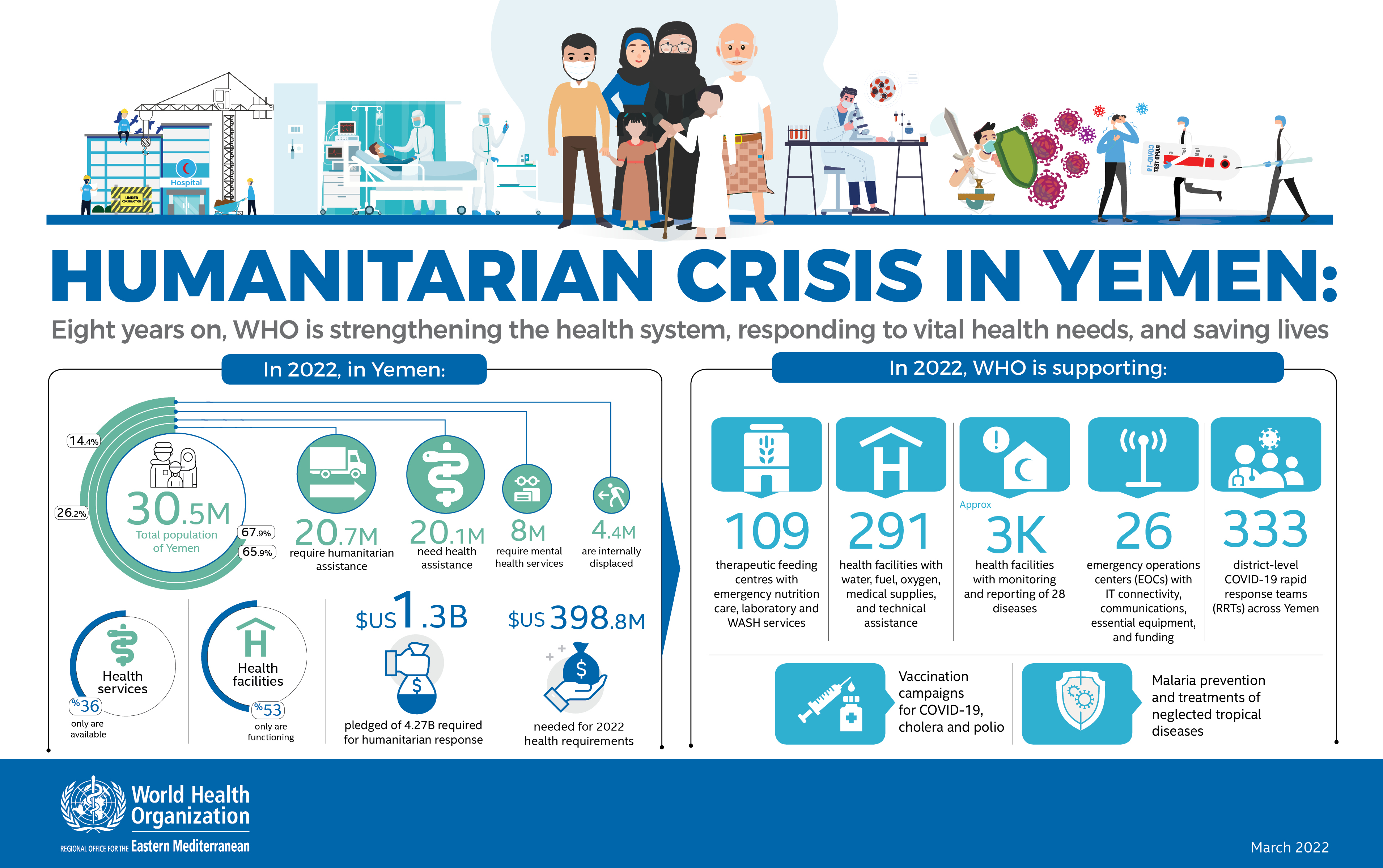
Yemen conflict is 'world's worst humanitarian crisis'be referred to (as)so many civilian casualties as well as combatants.2021The estimated number of direct and indirect deaths combined through the end of the year is377,000Climb to the person,4.2 millionThe number of people who were displaced is not uniform. There is no uniformity in the types of damage caused by conflict. Here we will look at the causes of humanitarian damage, which can be divided into direct causes of violence and indirect causes of non-violence.

Refugee camp in Lahij governorate, southwest Yemen (Photo:EU Civil Protection and Humanitarian Aid / Flickr [CC BY-NC-ND 2.0] )
The direct result has been conflict-related violence, which has killed many civilians as well as fighters. Both the Houthis and Saudi coalition forces are responsible for the damage, but Saudi airstrikes are reported to have caused the most severe damage.2015Since the year2022counter for years (following a number in the hito-futa-mi counting system)3Up to the month of MaydataAccording to the "Mere Old Man," the only confirmed airstrikes in Yemen by Saudi coalition forces have been25,000It has been done more than once,20,000Nearly 2,000 civilians have been killed or wounded. Cluster bombs, which disperse small bombs over a wide area, also cause severe civilian casualties,2015years and ...2016of the victims of the cluster bombs in 2006.91%.are civilians, injured not only during attacks but also by unexploded ordnance.
More problematic in this dispute, on the other hand, are the indirect causes.2021Estimated number of deaths by the end of the year377,000The People'smostlyare suffering so much that they are dying from indirect causes such as lack of food, water, and medical services. The most vulnerable to these causes of death are young children, who are the most susceptible to malnutrition,2021In the year5Children under the age of 18 are not eligible for this dispute.Nine minutes.1-ian (e.g. Italian, etc.) (attaches to name of country)has died.
and2022Those in need of humanitarian assistance for the year areApprox. 20.7 millionThis is about the same number of people in Yemen.To three.2-ian (e.g. Italian, etc.) (attaches to name of country)The population of the country is about 2.5 million people. of the population.More than halfhit the bull's-eye17.4 millionPeople are food insecure. caused by bacterial infections in the intestines and also by cholera, which is characterized by acute water-soluble diarrhea and vomiting.2016Many people have been affected since the outbreak in 2006.2016counter for years (following a number in the hito-futa-mi counting system)10from month to month2020counter for years (following a number in the hito-futa-mi counting system)12By MarchMore than 2.5 millionThere have been two suspected cases of cholera reported, which are1949at the age of ...WHOSince the start of cholera recording inworld's largestvalue.

A doctor examining a child's nutritional status (Photo:EU Civil Protection and Humanitarian Aid / Flickr [CC BY-NC-ND 2.0])
The humanitarian crisis due to indirect causes is exacerbated by the fact that the parties to the conflict are using ports and cities asblockadeand is causing shortages of food, medical supplies, relief supplies, and fuel, as well as rising prices of daily necessities. Saudi coalition forces are2015Since 2006, under the guise of preventing the smuggling of Houthi weapons, the army has been used to ground planes and berth ships in Yemen.checkThe port of Hodeidah, in particular, has been a major problem. In particular, the fuel blockade at the port of Hodeidah has been a major problem, as it was the port through which more than half of Yemen's commercial fuel flowed. to energy producing areas.aerial bombingalso made access to it impossible, causing fuel shortages.fuel shortagewill not only hinder the transportation of medical supplies and relief goods. The unavailability of generators makes it difficult to run hospitals and ensure clean water, leading to an increase in diseases such as cholera and acute water-soluble diarrhea. The new coronavirus, the first of the new coronaviruses4In addition to the wavediphtheriaThe increase in preventable diseases such as the following have disrupted an already fragile health care system.
The humanitarian crisis has also been greatly affected by the recent global situation. Rising food prices around the world, coupled with a lack of funding, have led to the United Nations World Food Program (World Food ProgrammeThe food aid that can be sent by thecurtailmentThe price of food and fuel has been rising. In addition, Russia's invasion of Ukraine has caused fuel and food prices to skyrocket. Ukraine is Yemen's wheat importer.31Although it accounted for a %,2015Compared to the year before2022counter for years (following a number in the hito-futa-mi counting system)3Prices as of March are approximately7doublesudden price jumpThe amount of humanitarian aid from other countries is also low. The amount of humanitarian aid from other countries is also small,2022Funds sought in aid to Yemen through the United Nations in 2006 are7As of May.27 % (%)Only an amount of
Realization of ceasefire
2015 The Yemen conflict has been causing the above-mentioned tragic humanitarian damage since 1949,2022counter for years (following a number in the hito-futa-mi counting system)4month1On Sunday, Hans Grundberg, the UN Secretary-General's Special Envoy for Yemen, said the conflict2announced that it had secured a cease-fire for a month, and the next day4month2Sunday afternoon Yemen time7The cease-fire went into effect at the time of the meeting. The UN had previously attempted to broker a ceasefire, but had been unable to reach an agreement due to opposition from the interim government and the Houthis.
This time a cease-fire was reached.primary factorIt is believed that both sides were so exhausted that they could benefit from a ceasefire as2022A series of events that have intensified the fighting between the Houthis and the side of the interim government since 2006 have brought the conflict to a state of equilibrium. When the conflict is in equilibrium, there is no pressure to favor one side or the other in terms of cease-fire conditions. Another factor is believed to be the economic damage to both regions caused by price hikes in world commodity markets.
The number of civilian deaths has decreased significantly since the ceasefire began and the war situation has improved. The ceasefire, which called for a cessation of all military operations by the parties to the conflict as a condition of the ceasefire, has led to a significant decrease in the number of civilian casualties in Yemen compared to the pre-conflict2Months456against the people, after the ceasefire.2For the month of265People,41Percentage ofdecreasewas reported.2022Before the cease-fire in 1949.3The ceasefire has had a significant impact on civilian infrastructure since the start of the ceasefire, as airstrikes, which had accounted for the majority of armed actions affecting civilian infrastructure during the first three months of the ceasefire, have been halted.decreaseThe first time, the company was in a position to do so.
Also, Saudi Arabia's embargo on fuel to the port of Hodeidah, which had beenmitigationThe fact that I did it,2During the month-long cease-fire18Fuel shipments were authorized for the vessels. This delivered food and clothing to the port of Hodeida.
furthermore6Commercial flights from Sanaa Airport, which had been banned for nearly two years, were resumed and weekly2Once flights to Jordan and Egypt were decided. The Interim Government-Saudi coalition forces in Sanaa used passports issued by the Houthi authorities for travel.permitmade. Increased safe mobility will also facilitate access to essentials and medical services.
Then, starting June 2, the ceasefire agreement signed in April was extended. The extension of the ceasefire, which brought about the improvement of the situation described above, is expected to further improve the situation.

But on the other hand, as they move into previously inaccessible areas, the cease-fire to2Months later, casualties from landmines and unexploded ordnance were the ceasefire's2From a month agoincreaseThe number of armed acts has generally decreased. Although armed actions have generally decreased, there are still frequent reports of violations of the ceasefire agreement by both parties.Taiz Statewell2016The area has been under the control of the Houthis since 1949, and roadblocks have been in place, but despite the fact that the opening of roadblocks is required as a condition of the current ceasefire, there are still issues to be addressed, including the fact that the opening of roadblocks has not yet progressed.
The Yemen Conflict as a Global Problem
As noted above, the Yemen conflict is a tangle of political objectives of multiple forces, each responsible for the disastrous situation.
The U.S. and other Western countries continue to provide military support, mainly in the form of arms, and even when they are not providing arms, they are still providing Saudi Arabia's oilrely onFew countries, including Japan, have strongly criticized or condemned the military actions of the Saudi coalition forces. One reason for this is that the adjustment of world oil prices is notSaudi Arabiacooperation is considered essential. In such a situation,2022counter for years (following a number in the hito-futa-mi counting system)7U.S. President Joe Biden will visit Saudi Arabia in May. Mr. Biden will be in charge of a stable energy supply for the Middle East, in light of sanctions against Russia and opposition to China.focal pointand it is unlikely that the U.S., which has been complicit in the conflict on the side of Saudi Arabia in the past, will exert pressure on Saudi Arabia to resolve the conflict.
After nearly seven years of conflict, the Yemeni conflict has entered a new phase that is expected to improve the war situation. With the big picture in mind, we will keep a close eye not only on the ceasefire situation in this conflict, but also on the movements of multiple forces and the impact of the global situation.
note (supplementary information) symbol1 Then a one-year term of office.extensionThe first time the company was founded, it was a small company.
2 Flag with Houthi slogan in Arabic: "God is great, death to America, death to Israel, curse the Jews, and victory over Islam."It says.The following is a list of the most common problems with the
Writer: Chika Kamikawa
Graphic: Mayuko Hanafusa




I have a friend who is a doctor working in Yemen. He was born in Japan, orphaned by his parents' car accident, and moved abroad to study and become a doctor. He was shot in the leg and lives without food and only on medicine, but there is nothing we can do to help him! He wants to go back to Japan. He wants to go back to Japan and get proper medical treatment.